



This post is also available in:
 English
  Tamil
Tamil
The time between your 11 AM call and 12 o’clock meeting is 15 minutes. You have been sitting for 3 hours now. Your back is tight in the lower back. Your energy is getting low. You also know that if you don’t get up and get moving, the rest of the afternoon will be like walking through wet sand.
There’s no time to head to the gym. Change into gym clothes and back in 15 minutes or less. A stroll around the building will help, but not much to relieve the tiredness and tension developing since 8 AM.
What you need is a 15-minute high-low HIIT micro workout. Can be done in your office, or in your home workspace, or anywhere there’s a 2-meter square of an empty floor in a work suit, without any equipment, with enough intensity to energize you all the way back to the start, but not so intense that you arrive dripping with sweat at your desk.
Why short workouts work
For decades, the fitness industry has been preaching a message to people that says they have to exercise for long periods of time to get results. Forty-five minutes minimum. An hour is better. Not quite that is not worth doing.
This is wrong. And in the past decade, research has thoroughly determined why.
Short, high-intensity exercise creates quick hormonal reactions that moderate, longer exercise does not. A 10- to 15-minute high-intensity session increases adrenaline, blood flow to the brain and releases BDNF, a protein that enhances cognitive function, focus and mood in minutes after the exercise is finished. This is the scientific explanation for the “mental clarity” that people experience after a short, intense exercise session.
These are not compromises for the urban Sri Lankan professionals who do not need to burn calories but to restore and recharge energy and reset the mind in the middle of the day. They are the right ones to do the job.
The high-low structure, which involves hard work/ easy active recovery alternation, further magnifies these by boosting and intensifying the contrast that sets up a rapid firing of the body’s stress-response/recovery system. This cycling is the reason that 15 minutes of micro training feels like pressing a reset button on your afternoon – the energy reboost and the mood lift, as well as the afterburn.
The 15-Minute High-Low HIIT Protocol
This exercise combines four movements. No equipment. No change required. A clear area of around 2 metres x 2 metres is sufficient. The workout is a structure of 40 seconds of high effort followed by 20 seconds of low intensity, active recovery (repeated 4 times).
2 minutes of preparation before starting. Body weight squats: Slow body weight squats for 10 reps forward and 10 reps backward. Slow arm circles: Slow arm circles forward and backward for 10 each. This is sufficient to warm up the joints and get the heart rate up slowly before it gets tough.
Round 1: squat and recover
High effort (40 seconds): Jump squat or fast bodyweight squat (if jumping is not suitable). Drive through heels, chest up and get your heart rate up fast.
Low recovery (20 seconds): Gently swing the arms whilst walking on the spot.
Round 2: Push and Recover
High effort (40 seconds): Push-ups done at a fast but controlled pace. If regular push-ups are challenging, do an incline push-up (hands on the desk or chair) that puts less stress on the push-up but keeps the muscle pattern the same.
Low recovery (20 seconds): Slow step on spot.
Round 3: Lunge and Recover
High effort (40 seconds): Alternating reverse lunges at a fast speed. Move 1 step back, bending your knee toward the floor, then stand back up and step back and down the other foot. Do not let your front knee go forward of the toes at any time.
Slow recovery (20 seconds): Slow on the spot walk.
Round 4: Core Drive and Recover
High effort (40 seconds): Mountain climbers in a moderate to fast pace plank position, driving alternating knees toward chest. It is the most demanding cardiovascular activity of the four movements and intentionally placed as the last one when you are already working hard.
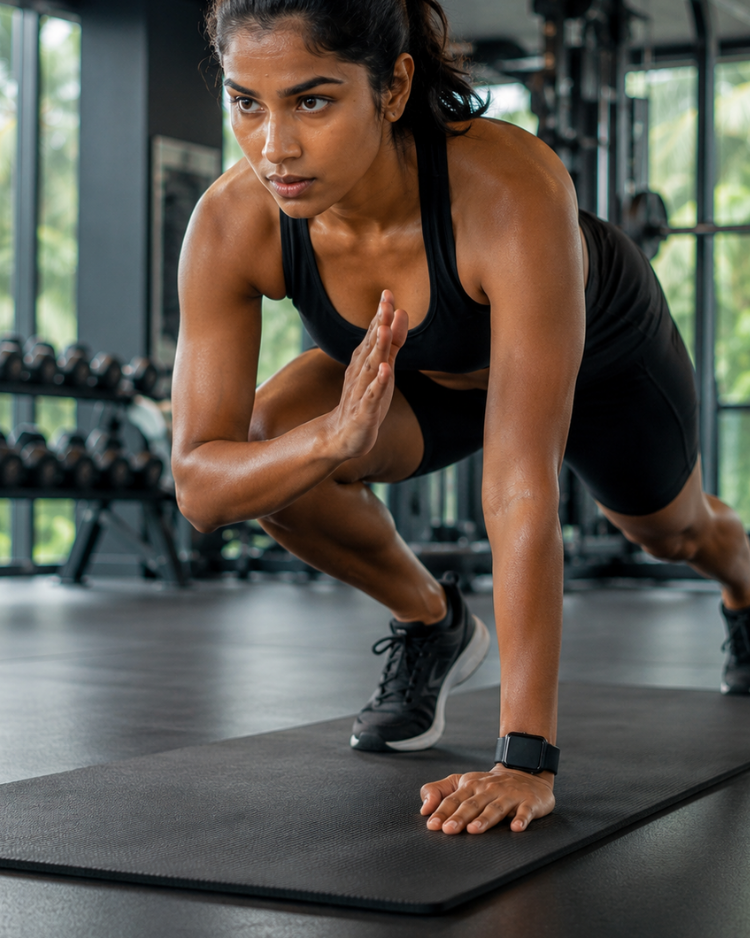
Low recovery (20 seconds): Stand and slowly breathe in and out, hands on hips
Complete the 4-round circuit twice more for a total of 8 rounds. That’s the exercise: 13 minutes and 20 seconds of work, with a 2-minute warm-up at the beginning and a 60-second cool-down at the end, consisting of slow breathing and shoulder rolls.
The total time for warm-up to completion: 16 minutes. Come back to your workstation within 17 minutes of leaving it.
How to Control Sweat in a Professional Environment
It’s the question that we are all asking ourselves, but few fitness articles are answering straight when it comes to Sri Lankan office workers.
It’s the structure of a high-low that’s designed to maintain a high level of intensity while allowing it to be effective, but not so high that a healthy adult drench their clothes after 15 minutes of working. With the low recovery sessions every 20 seconds, there is some heart recovery during the recovery period, which means that the total sweat loss will be less than if they were doing the hard periods continuously.
Even this systematically organized plan will generate sweat in Sri Lanka’s hot climate. Small changes that can be implemented in the office include using a small hand towel to put on the wrists and neck to cool down immediately after the session (the perceived body temperature will be lowered quickly), and spending 3 to 5 minutes after the session with slow breathing before returning to seated work.
If you wear natural fabrics, such as cotton or linen, instead of synthetic fabrics while at work, the sweat will dry more quickly and won’t be seen. Trying to fit in your micro workout before a break at meals provides a little extra time before the next meeting.
Choosing the optimum time to do your micro workouts
The best time for a midday micro workout is from 11 am to 12 pm, and 2 pm to 3 pm on a Sri Lankan professional’s day. Both breaks break the longest portion of working time when energy levels start to drop.
The time (2 PM to 3 PM) is a very potent one, and the reason for this is that it is the time of post-lunch blood sugar crash. This is because exercising at this time will help to get glucose into the muscle at the very time it might be dropping, minimizing the afternoon slump and bringing alertness back in the final hours of the workday.
Three micro workouts a week, on Monday, Wednesday and Friday, are sufficient to make significant gains in cardiovascular fitness, core strength and afternoon energy levels after 6 to 8 weeks. Keeping their sessions daily if they are able to recover, and at least three times per week for long-term results.
The key here is to understand that it entails a better result for urban Sri Lankans than a gym
The gym is a great thing when the person who uses it can use it on a regular basis. Finding the time to exercise regularly is really challenging for the urban professional who has to get to work early in the morning, goes to work at odd hours and commutes for hours.
There are no excuses for not doing a micro workout because it does not involve traveling to a gym, requires no changing room, no waiting for gear, and no planning beyond a 15-minute window into your calendar. It eliminates all the obstacles to exercise in your way. Barriers are the reason people don’t exercise, not because they’re not motivated, but rather because of barriers.
A 15-minute micro workout three times a week each week for 6 months is vastly more effective than a gym membership for 6 weeks used intermittently, and then forgotten in frustration.
The Bottom Line
No hour required. A gym is not required. Equipment is not required. It takes you 15 minutes, a place where the floor is clear, and the determination to take your midday exercise break as seriously as a meeting.
Repeat three times a week. Do it consistently. Now experience how it affects your afternoon energy, attention and body over the next 2 months.
“Each event in the Calendar has a time period. So does your body! Fifteen minutes is the maximum and only if you take them.”












Discussion about this post