


This post is also available in:
 English
  Sinhala
All the diet plans you’ve tried have you heard the same thing. Eat less rice. Cut the carbs. Reduce your portions. Do not eat white rice. Go for brown rice. Eat salad instead.
If you’re a Sri Lankan, you’ve most likely attempted some form of this. You survived for several days. Maybe a week. But then, in front of you, was a plate of rice and curry, and the diet was over, and everyone went away quietly.
It’s not some sort of lack of willpower. It’s a design flaw. Eating plans that demand that Sri Lankans give up their eating habits do not work, not because they are incorrect, but because they are entirely at odds with the typical Sri Lankan lifestyle.
There’s a better way. It won’t make you sacrifice anything you eat on your plate.
A problem with how most Sri Lankans eat their meals
A traditional Sri Lankan meal contains all the elements of a good meal. Rice is a source of carbohydrates, which is used as an energy source. Dhal is a source of plant protein and plant fibre. Mallung is rich in vitamins, minerals and fibre. Enjoy protein and healthy fats with fish or chicken. Natural fats and flavour from pol sambol.
This is an actual healthy dish! It’s not about the food on the plate. It is the order in which most Sri Lankans eat it.
The majority of people begin with rice. They take a big bite, then add their curries around it and consume all the food from the first bite. The rice is the fastest to digest and gets digested as soon as it is consumed. Your blood glucose quickly increases. Your body produces insulin to control it. But after two hours, you feel tired, your head is foggy, and you’re hungry again, as if you had never eaten at all.
This process occurs 2 or 3 times per day and contributes to the blood sugar roller coaster that results in afternoon energy crashes, constant hunger, and, over time, insulin resistance that can result in Type 2 Diabetes.
This is not due to the rice itself. It is triggered by consuming rice first, in isolation, on an empty stomach, so that the glucose in rice goes into the blood without anything to slow it down.
Understanding the Science behind Eating Order
The research of the past ten years has yielded some of the most interesting insights into nutrition science and they apply to Sri Lankan diets.
Researchers at Weill Cornell Medical College and at Japanese institutions have found that the sequence in which the components of a meal are consumed matters greatly for the resulting spike in blood sugar after the meal.
Consuming protein and fibre before carbohydrates will help to delay the digestion and absorption of carbohydrates. Fibre slows down food moving through your digestive system. Protein stimulates the hormones that make you feel full and that delay stomach emptying. Both effects delay the glucose from your rice being absorbed into the bloodstream, causing a more gradual and less severe increase in blood sugar levels than if the rice was consumed all at once.
There’s a big distinction. Research indicates that consuming vegetables and protein prior to carbohydrates helps lower the rise in blood glucose levels after meals by 30-40% relative to eating all three at once, or eating carbohydrates first. This is no mere finickiness. A very different metabolic reaction to the same meal!
But most importantly, you are eating the same food! The same rice. The same dhal. The same mallung. The same fish. In a different sequence.
Application to a Sri Lankan Meal
The application to a meal in Sri Lanka is straightforward and there is no need to change anything in your cooking or purchasing of food.
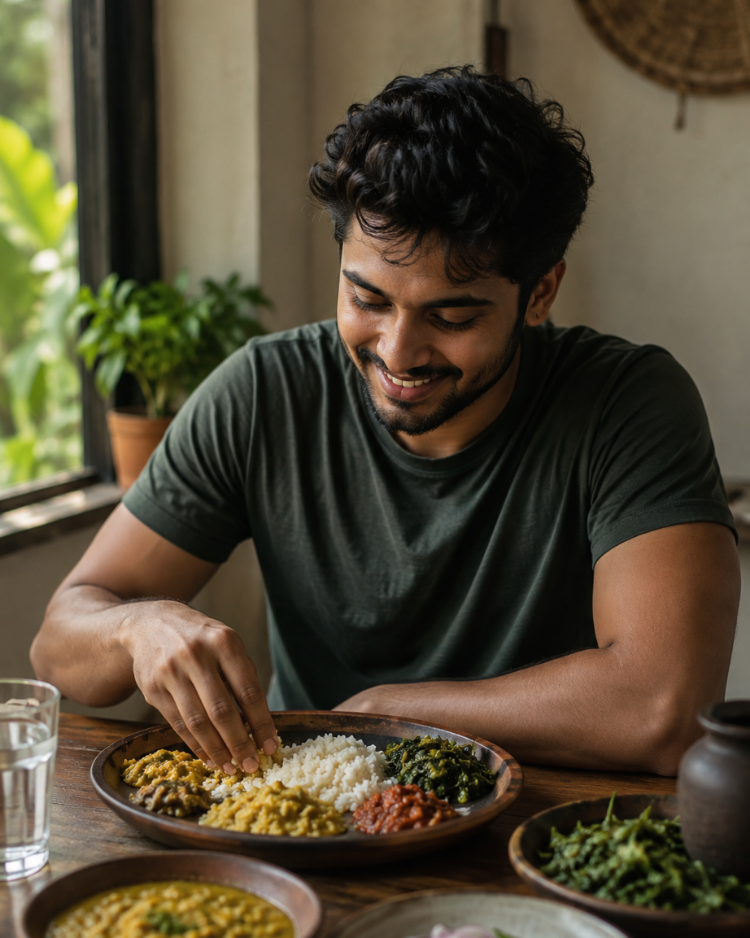
The best way to eat your rice and curry is to begin with the vegetables at home, at the canteen, or at a restaurant. Consume your mallung, vegetable curry, salad, or any leafy greens first. Take them very slowly and eat them before anything else.
Next, go to your protein. Then eat your fish/chicken/dhal/egg. Don’t hurry through this course. The fibre from the vegetables and protein from your primary food are now lining the walls of your digestive system and readying your body to take in the carbohydrates that come next.
Now eat your rice. Once the glucose from your rice has started to digest, it has to go through the rough, fibrous and protein-rich material already in your stomach. The digestion is delayed. The glucose release is more sustained. The blood sugar curve is more level. And the energy you get for the next 2-3 hours is a lot more even.
Also referred to as glucose sequencing or meal sequencing. In Japan, the traditional maitake eating method is indeed based on this principle: Vegetables first, protein second, and carbohydrates last. In Sri Lanka, there are always the right ingredients on our plates. All we need to do is change our eating habits for each one.
The Benefits Beyond Blood Sugar
After eating a meal, if your blood sugar doesn’t spike, there are a few things that happen that are more than just you not feeling the afternoon slump.
You feel less hunger faster and more real. High blood glucose levels are followed by sharp declines that signal hunger, even if you have a lot of stored energy in your body. When your blood sugar is stable, you feel hungry, not hungry in a crashing 90 minutes after lunch, but hungry after 2-3 hours.
You are able to lose weight without limiting anything. When individuals who practice glucose sequencing do so on a regular basis, they experience steady weight loss over time, without altering anything they eat, except when each item is consumed.
Your energy levels dramatically improved in the afternoon. Most of the fog experienced in the afternoon by most Sri Lankan office workers is due to the fall in blood sugar following a high carbohydrate meal. The blood sugar curve for lunch is shallower or flat when the blood sugar curve is flatter. Many people who have tried this say that they are truly awake all afternoon, for the first time in many years.
Making It Work in Real Sri Lankan Life
In the Sri Lankan context, the biggest challenge of meal sequencing is the mixing of food items or eating together, with sometimes complex issues for separating components.
Finally, it’s as simple as serving your plate a certain way at home. Put the mallung and vegetable curry on one side of your plate and start eating from there. Once finished, transfer to the fish or dhal. Then eat the rice.
In a canteen or lunch boutique, name the food items one by one on the plate and consume them one after another. This only takes about 10 seconds of intent and no special instructions to the kitchen.
Do the best you can at a family dinner or when a meal is provided at a social gathering. Eat vegetables first, a few bites of protein, then add in the rice. Even if you only see the beginning of the sequence, it will have a positive effect. It doesn’t have to be perfect; it’s about consistency.
The Bottom Line
Rice isn’t something you have to eliminate. There’s no need to sacrifice your favorite Sri Lankan dhal, pol sambol, mallung, or even your entire meal. You need to change the order in which you eat them.
Vegetables first. Protein second. Rice last. This is all you do in the intervention. Three words that impact your energy, your weight, your blood sugar and your food relationship without changing a single ingredient on your plate.
“The issue wasn’t the rice; it was a lack of technology. It was always the way it was. Mix up the routine, don’t change the food and see how things go for the rest of the day.”










Discussion about this post